A good cheat sheet does one job: it puts the answer in front of you faster than your memory can. These four are built for that. Each fits on a single A4 page, prints cleanly on a home printer, and carries numbers that were counted in full rather than copied from somewhere else. Pick the one you need, or take all four.
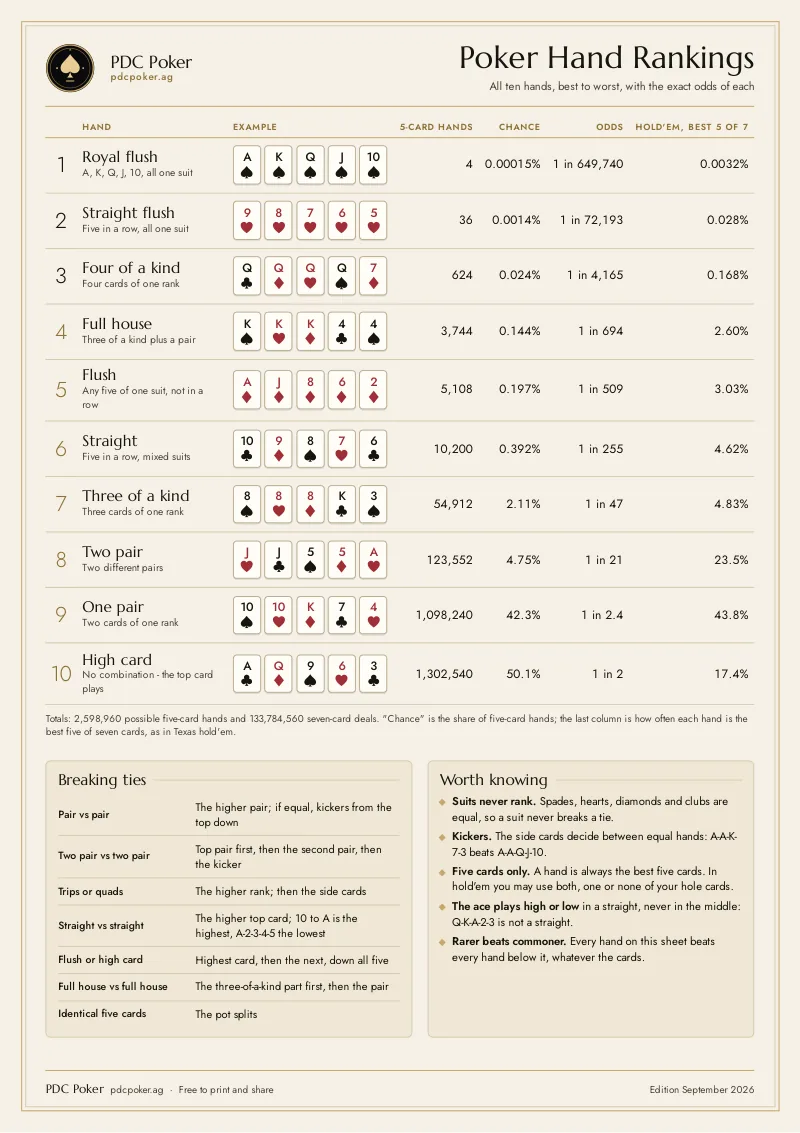
Poker hand rankings
All ten hands in order, each with example cards, the number of five-card hands that make it, the chance and the odds, plus how often it is the best five of seven in hold'em. A tie-break panel covers kickers and split pots.
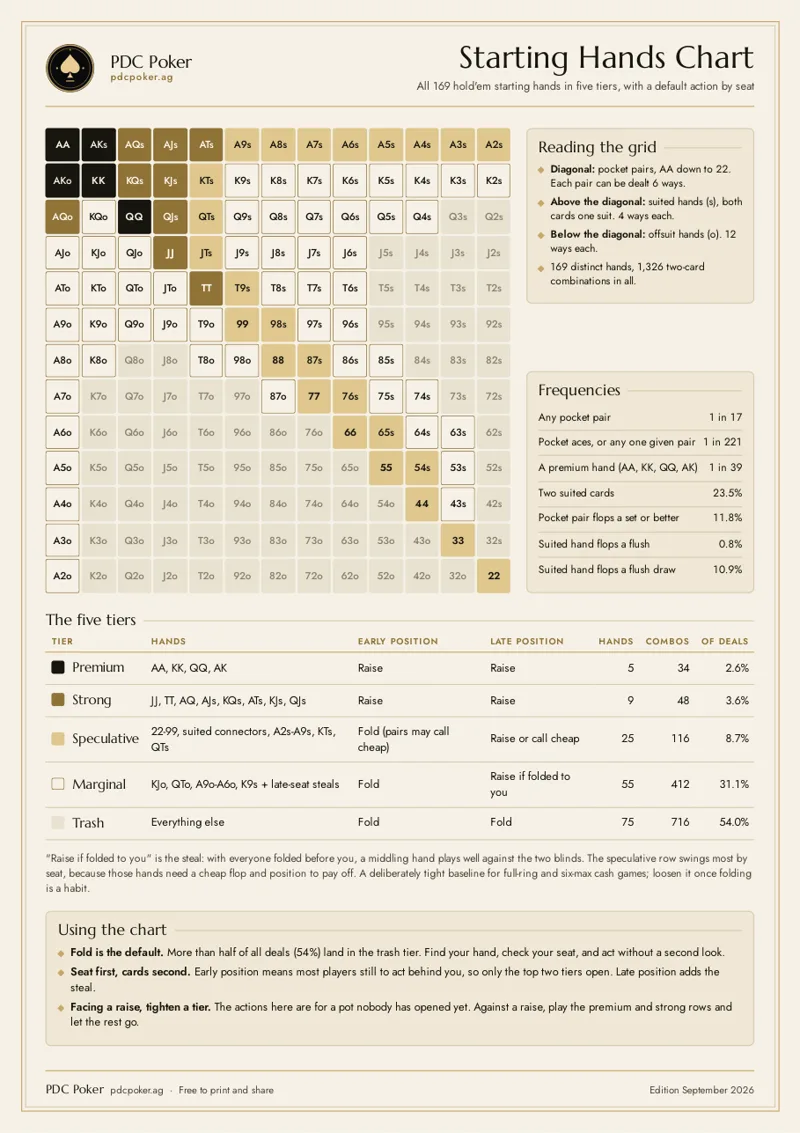
Starting hands chart
The full 13 by 13 grid of 169 hold'em starting hands, shaded in five tiers that print cleanly in black and white. The tier table gives a default action for early and late position and the share of deals each tier covers.
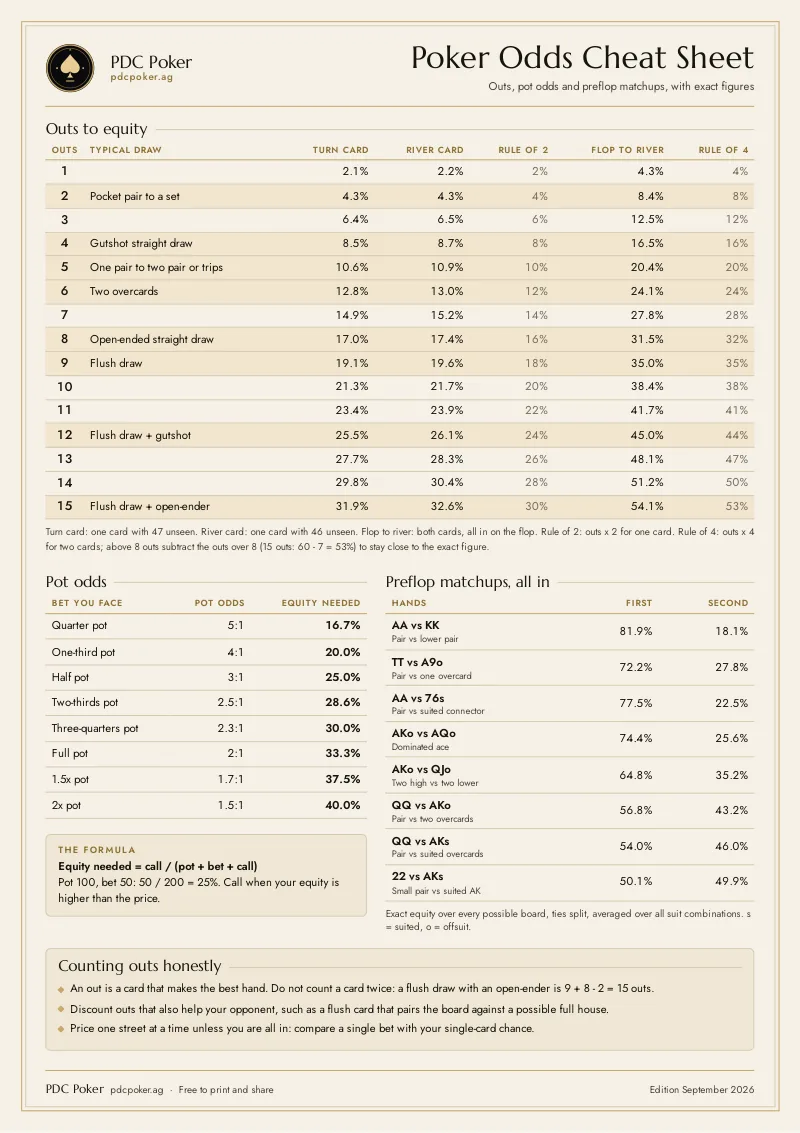
Poker odds cheat sheet
Outs from 1 to 15 with the exact chance on the turn, the river and from flop to river, set beside the rule of 2 and 4. Pot odds for eight bet sizes and exact all-in equity for eight classic preflop matchups.
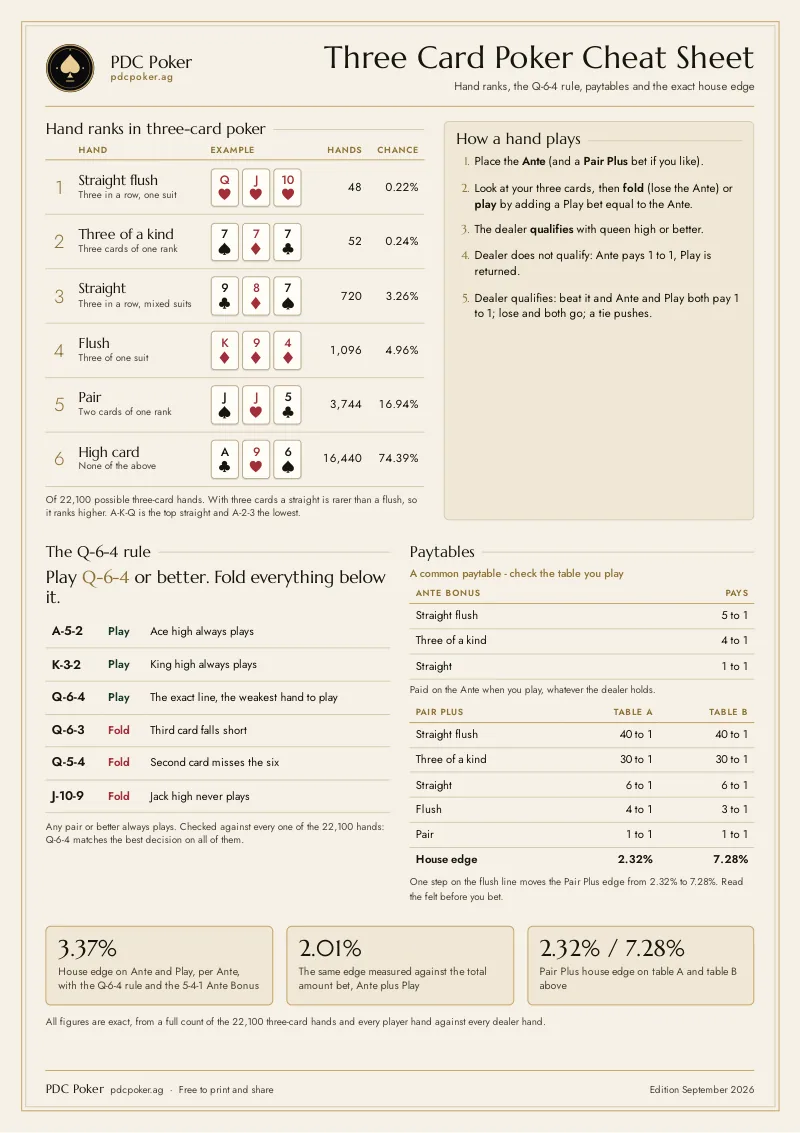
Three card poker cheat sheet
The six three-card hand ranks with their counts, how a hand plays, the Q-6-4 rule with worked examples, the Ante Bonus and two Pair Plus paytables, and the exact house edge of each bet.
Poker hand rankings: the sheet to learn first
The rankings sheet lists the ten hands from royal flush down to high card. Each row shows an example hand in real cards, the number of five-card hands that make it, the chance of being dealt it, and the odds as "1 in" a round number. The last column answers the question beginners actually ask at a hold'em table: how often is this the best five of my seven cards? A flush is dealt in five cards about once in 509 hands, yet it ends up as the best hand of seven cards about 3% of the time.
Keep it next to the table for your first few home games. Most arguments at a new table are not about which hand is bigger but about ties, so the lower half of the sheet covers kickers, two pair against two pair, and the rule people forget most: suits never break a tie. The full story, with every hand explained, is on the poker hand rankings page.
Starting hands chart: fold with confidence
The chart puts all 169 distinct hold'em starting hands on one 13 by 13 grid. Pocket pairs run down the diagonal, suited hands sit above it and offsuit hands below it. Five shades mark the five tiers, from the premium four to everything else, and they are chosen to stay apart even on a black and white printer. Below the grid a table gives the default play from early and late position, and how much of the deck each tier covers: the trash tier alone is about four deals in five.
Use it while studying, not while guessing. Sit with a deck, deal yourself two cards, find them on the grid and say the action out loud before you look. After a few hundred deals you will stop needing the sheet, which is the point. The reasoning behind each tier is on the starting hands guide, and the all-in or fold drill is a quick way to test yourself once the chart feels familiar.
Poker odds cheat sheet: outs, prices and races
The odds sheet is the one players keep in a notebook for years. Its top table turns outs into a chance: one card to come on the turn, one card to come on the river, and both cards when you are all in on the flop. Beside the exact numbers sit the shortcuts most players use, the rule of 2 and the rule of 4, so you can see where they hold and where they drift. With 15 outs the rule of 4 says 60%, the real figure is 54.1%, and the sheet shows the simple correction.
The pot odds table converts a bet into the equity you need to call, from a quarter of the pot at 16.7% to twice the pot at 40%. The matchup table gives exact all-in equity for eight classic preflop spots, such as aces against kings at 81.9% to 18.1%, and a pair against two overcards, which is closer to a coin flip than many players expect. The poker odds section explains each number, and the odds trainer lets you practise them against the clock.
Three card poker cheat sheet: one rule and the real edge
Three card poker has a short strategy and a long list of paytables, and the sheet covers both. It shows the six hand ranks with their counts, including the detail that surprises new players: with three cards a straight is rarer than a flush, so it ranks higher. Then comes the Q-6-4 rule, which says to play any hand of queen, six, four or better and fold the rest, with six worked examples.
The paytable panel shows the Ante Bonus and two Pair Plus tables side by side. Their only difference is the flush line, 4 to 1 against 3 to 1, and that one step moves the house edge on Pair Plus from 2.32% to 7.28%. Take the sheet with you and read the felt before you place the bet. You can try the game without stakes at our free three card poker table.
Printing tips
Print at 100% or "Actual size" for the sharpest result; the sheets are vector files, so text and lines stay crisp at any size. On US Letter paper choose "Fit to page". The cream background is light enough for everyday printing, and greyscale works too: the tier shades and highlighted rows were picked to stay distinct without colour.
For a sheet that lasts, print on heavier paper, around 160 to 200 gsm, or slide it into a clear sleeve. Two sheets back to back in one sleeve, rankings on the front and odds on the back, make a handy study card. And since the files are free to share, print a spare for the friend who always asks what beats what.