How the table works
You start with 100 credits. Bet One raises your stake a coin at a time, up to five; Bet Max pushes the bet to five coins and deals in one motion. Press Deal and five cards land face up. Tap the ones worth keeping - a Held tag appears over each - then press Draw and the machine replaces everything else. If the final hand is a pair of jacks or better, the matching row on the paytable lights up and the win drops into your balance.
That is the whole loop, and it is quicker than reading about it. Keyboard players can run it without touching the mouse: keys 1 through 5 toggle holds, Space deals and draws. Your credits are saved in the browser between visits, so a good session is still there tomorrow. Go broke and New Game resets you to 100 credits, which is a friendlier arrangement than any casino cage. A small speaker button in the corner mutes the machine - every chirp and win chime is synthesized right in the page, and the math works exactly the same in silence.
The machine pays on nine hand types, from a single high pair up to the royal flush. If those names are still fuzzy, spend ten minutes on the Hand Trainer first - video poker assumes you can read your own five cards at a glance.
One bet, one deal, one decision, one draw - then the paytable settles it.
The paytable, row by row
This machine runs the schedule players call "9/6" or full pay, after its two telltale rows: full house pays 9 and flush pays 6. Those two numbers are how you judge any video poker machine in the wild, because they are the rows casinos quietly trim.
| Hand | 1 coin bet | 5 coin bet |
|---|---|---|
| Royal flush | 250 | 4,000 |
| Straight flush | 50 | 250 |
| Four of a kind | 25 | 125 |
| Full house | 9 | 45 |
| Flush | 6 | 30 |
| Straight | 4 | 20 |
| Three of a kind | 3 | 15 |
| Two pair | 2 | 10 |
| Jacks or better | 1 | 5 |
Look at the royal flush row. At one to four coins it pays 250 per coin, but at five coins it jumps to 4,000 instead of the proportional 1,250. That single jump is why the standard advice is to bet max or lower your coin size: the five-coin royal pays 800 to 1, and the smaller bets pay 250 to 1 for the same hand. With perfect decisions this schedule returns about 99.5 percent over the long run - the royal itself arrives roughly once in 40,000 hands, so patience is part of the price.
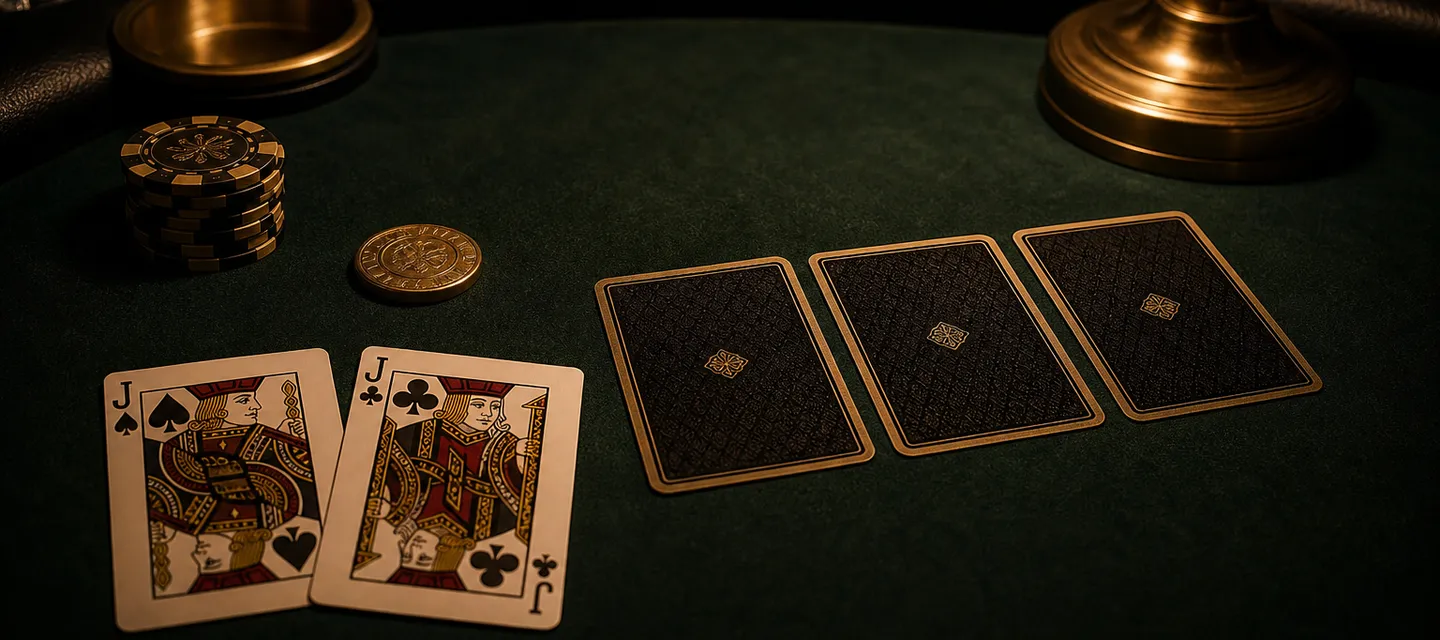
- Keep any made paying hand - a pair of jacks or better stays, unless four cards of a royal are staring at you
- A low pair beats two unsuited high cards - hold the pair, draw three
- Four to a flush beats a low pair - the draw is worth more than the made nothing
- Never hold a kicker next to a pair - the fifth card adds no value, only lost draws
- Do not break a made straight or flush for anything smaller than a royal draw
Common beginner mistakes
- Holding a kicker with a pair "for luck"
- Keeping three scattered high cards instead of the suited two
- Breaking a made flush to chase a bigger pat hand
- Forgetting that a pair of tens pays nothing at this table
- Playing fast on feel instead of reading the grade after each hand
What it trains
Video poker is a pure decision drill. There are no opponents, no bluffing and no position - just five cards, one draw, and a paytable that rewards the mathematically correct hold every single time. That makes it the cleanest place on the games floor to practice hand reading under mild pressure: you have to spot the pair, the four-flush and the open-ended straight draw in the same five cards, then decide which is worth more.
It also teaches expected value in a way tables rarely do. Holding a low pair feels weak and holding four to a flush feels thin, yet each is right in its spot, and over a few hundred hands the balance sheet makes the argument for you. A working grasp of hand rankings turns those calls from guesses into arithmetic.
Tips from the rail
- Keep a paying pair of jacks or better over a four-card flush draw, because the sure payout plus the chance to improve beats the one-in-five flush chance.
- Do the opposite with a low pair: four cards to a flush make money more often than a pair of sixes ever will, so chase the flush and let the small pair go.
- Never hold a kicker next to your pair. The extra ace looks reassuring and costs you a full replacement card every time it rides along.
- Do the arithmetic before breaking a made hand: the only standard exception worth learning is four to a royal, where the 4,000-coin jackpot justifies tossing a made flush or a paying pair.
- If nothing in your hand is a jack or higher and no draw exists, throw all five away. A fresh hand beats loyalty to garbage.