How Three Card Poker works
Three Card Poker is two small games sharing one deal. Both start with a bet, and you can back either one or both on the same hand. The main game is Ante and Play against the dealer. The side game is Pair Plus, a straight bet on the strength of your own three cards. The table above deals the real thing, so you can learn the rhythm before any of it costs you a chip.
To play the base game you post an Ante. The dealer gives you three cards face up and takes three for the house, one of them hidden. Now you make a single decision: fold and give up the Ante, or Play by matching it with a second bet equal to the Ante. There is no drawing, no swapping and no second round of betting. You look at three cards and you either commit or you leave.
- Play any hand of Queen-6-4 or better; fold everything weaker
- Any king-high or ace-high hand plays automatically
- A queen-high hand plays only if the next cards reach six and four
- Pair Plus is optional and completely independent of the dealer
- Remember: a straight beats a flush in three cards
The dealer qualifies on Queen high
After you act, the dealer turns the hidden card. The house hand has to qualify, and the bar is Queen high or better. If the dealer misses that bar, your Play bet is returned and your Ante pays even money, whatever the cards say. If the dealer qualifies, the two hands are compared: beat a qualified dealer and both the Ante and the Play pay even money, lose and both bets go to the house. This qualifier is the quiet engine of the game. It is the reason a modest hand is still worth playing rather than folding on sight.
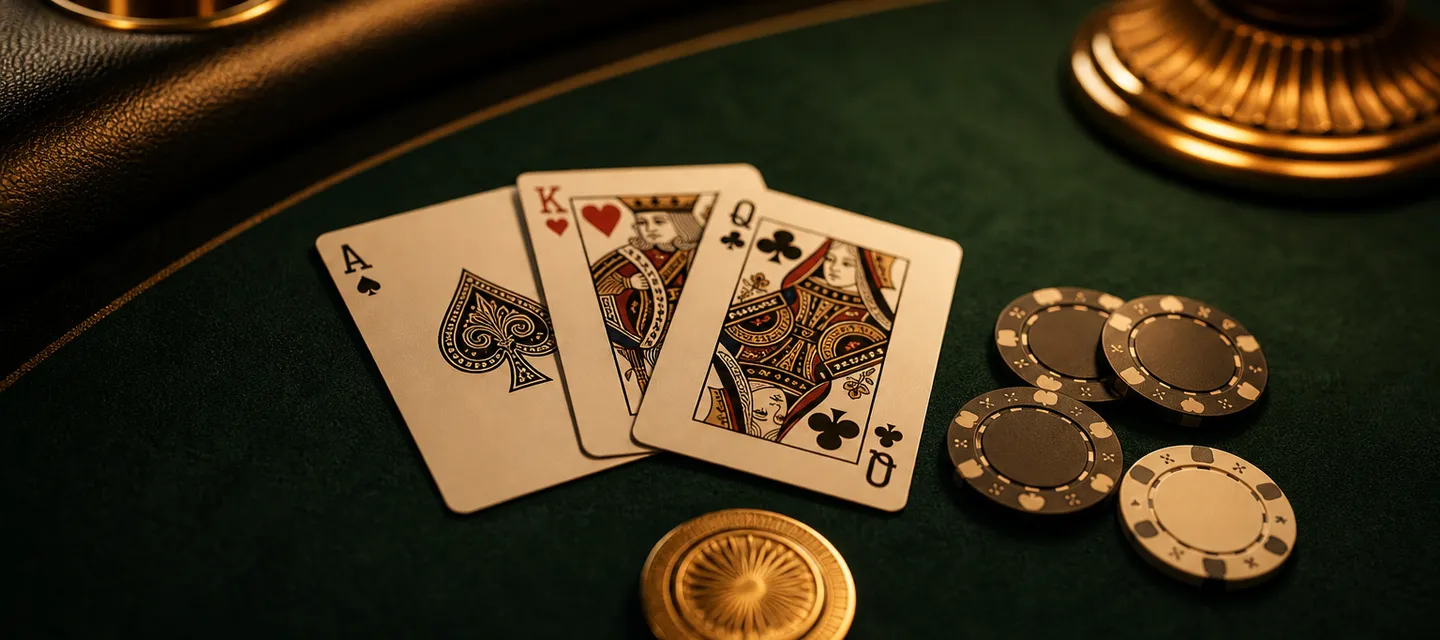
Hand rankings, with one surprise
The ladder is the shape you already know from poker, shortened to three cards: straight flush, three of a kind, straight, flush, pair, high card. The surprise sits near the top. In Three Card Poker a straight beats a flush, the reverse of the five-card order. The reason is pure counting: with only three cards a flush is easier to make than a straight, so the straight ranks higher. Keep that straight-over-flush rule in mind, because it changes how you value a hand at showdown. The rest of the order matches what you will find in the full hand rankings.
The gold pair is the twist: in three cards the straight outranks the flush.
The counts explain the twist. From one 52-card deck there are 22,100 possible three-card hands, and the numbers below are every one of them sorted by class. Flushes outnumber straights by more than 370 hands, so the rarer straight takes the higher rung.
| Hand | Hands | Probability |
|---|---|---|
| Straight flush | 48 | 0.22% |
| Three of a kind | 52 | 0.24% |
| Straight | 720 | 3.26% |
| Flush | 1,096 | 4.96% |
| Pair | 3,744 | 16.94% |
| High card | 16,440 | 74.39% |
Pair Plus and the payouts
Pair Plus ignores the dealer entirely. You are paid for making a pair or better, on a schedule that climbs steeply: a pair returns even money, then a flush, a straight, three of a kind and a straight flush each pay progressively more. You cannot lose Pair Plus to a stronger dealer hand, only to your own weak cards, so it is the pure gamble on this felt. It swings hard and it is good fun. The Ante and Play game is the one that rewards study.
| Pair Plus payouts (this table) | |
|---|---|
| Straight Flush | 40 to 1 |
| Three of a Kind | 30 to 1 |
| Straight | 6 to 1 |
| Flush | 3 to 1 |
| Pair | 1 to 1 |
| Ante Bonus (paid win or lose) | |
|---|---|
| Straight Flush | 5 to 1 |
| Three of a Kind | 4 to 1 |
| Straight | 1 to 1 |
Play or fold: worked examples
The Q-6-4 line sounds abstract until you hold a few hands against it. These are the calls the rule makes for you - deal them at the table above and check yourself.
| Your hand | Action | Why |
|---|---|---|
| A-5-2 | Play | Ace high always plays, whatever follows it |
| K-3-2 | Play | King high always plays too |
| Q-6-4 | Play | The exact border - this is the weakest playable hand |
| Q-6-3 | Fold | One pip under the line - the third card falls short |
| Q-5-4 | Fold | The second card misses six, so the hand goes away |
| J-10-9 | Fold | Pretty, but jack high never plays - no queen, no game |
Common beginner mistakes
- Reading the ladder in five-card order and mucking a straight that just beat a flush
- Playing every queen-high hand - Q-6-4 is a border, not an invitation
- Treating Pair Plus as the main game when it is the pure-gamble side bet
- Forgetting the qualifier: against a non-qualifying dealer your Play bet simply comes back
- Chasing a bad session faster instead of folding the trash on sight
House edge and the one rule to remember
Played correctly, the Ante and Play game carries a house edge of roughly 3.4 percent on the Ante. That is respectable for a table game and kinder than most side bets in the room. Pair Plus on the 1-3-6-30-40 schedule shown above keeps about 7.3 percent of every bet over the long run: multiply each payout by its count from the probability table, subtract the 16,440 losing hands, and the total lands at minus 1,608 units per 22,100 hands. Tables that pay 4 to 1 on a flush cut that edge to roughly 2.3 percent, which is why the paytable matters more than any Pair Plus "system". Correct strategy is famously short: play any hand of Queen, Six, Four or better, and fold everything below it. That single line captures nearly all of the available edge. If your highest card is a king or an ace, you play. If it is a queen, you check the next two cards against six and four. Anything weaker is a fold. Thinking about prices on other games? The same discipline shows up in our guide to pot odds.
Practice it here first
Real money makes people rush and second-guess a decision the math already settled. The free table removes that pressure, so you can drill the one rule until it is automatic. Deal a few hundred hands, fold the trash on sight, and you will feel how often a bare queen high is a fold and how often a spot on the ladder rescues a scruffy-looking hand. Once the Q-6-4 line is second nature you will play faster and leak far less than the player beside you who is going on feel. When you want a fuller game, the rest of the tables are waiting on the games floor.
Where to go from here
Fix the shortened ladder against the full five-card order in the hand rankings guide, see what a price really costs in poker odds, or take the longer road at the Hold'em table. The whole games floor is free, and every table deals the moment you arrive.