
These poker hand rankings list every hand in order of strength. Odds are for a random five-card deal; in Hold'em you build the best five from seven cards, so made hands arrive more often - but the poker hands in order never change.
Most players can recite the ladder - the real skill is spotting it at the table without hesitation.
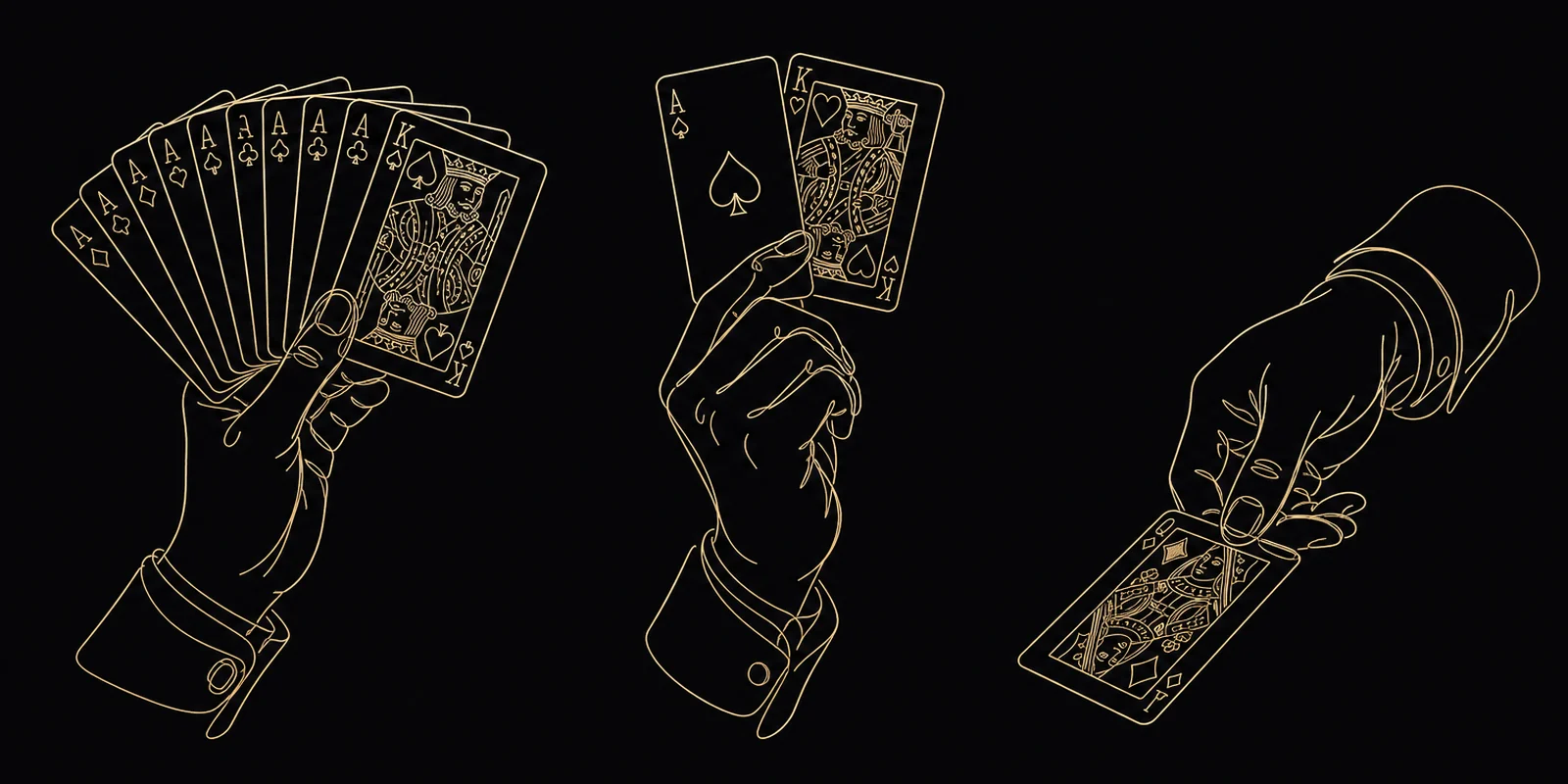
How the poker hands ranking chart works
The poker hand rankings are not arbitrary; the chart is rarity, written down. A flush beats a straight because five cards of one suit are harder to make than five in a row. Four of a kind beats a full house for the same reason. Once you see the poker hands in order as a rarity chart, you stop memorising and start understanding - and the numbers on the odds desk begin to make intuitive sense.
Two details trip up newer players. First, the ace works both ends of the ladder: it is the high card in A-K-Q-J-10 (broadway) and the low card in 5-4-3-2-A (the wheel), but it cannot wrap around the middle - Q-K-A-2-3 is nothing. Second, there is no ranking among suits. A spade flush does not outrank a heart flush; if two flushes meet, the highest card in each decides it.
Most arguments start after the ranking list ends: when two made hands match, the side cards finish the comparison.
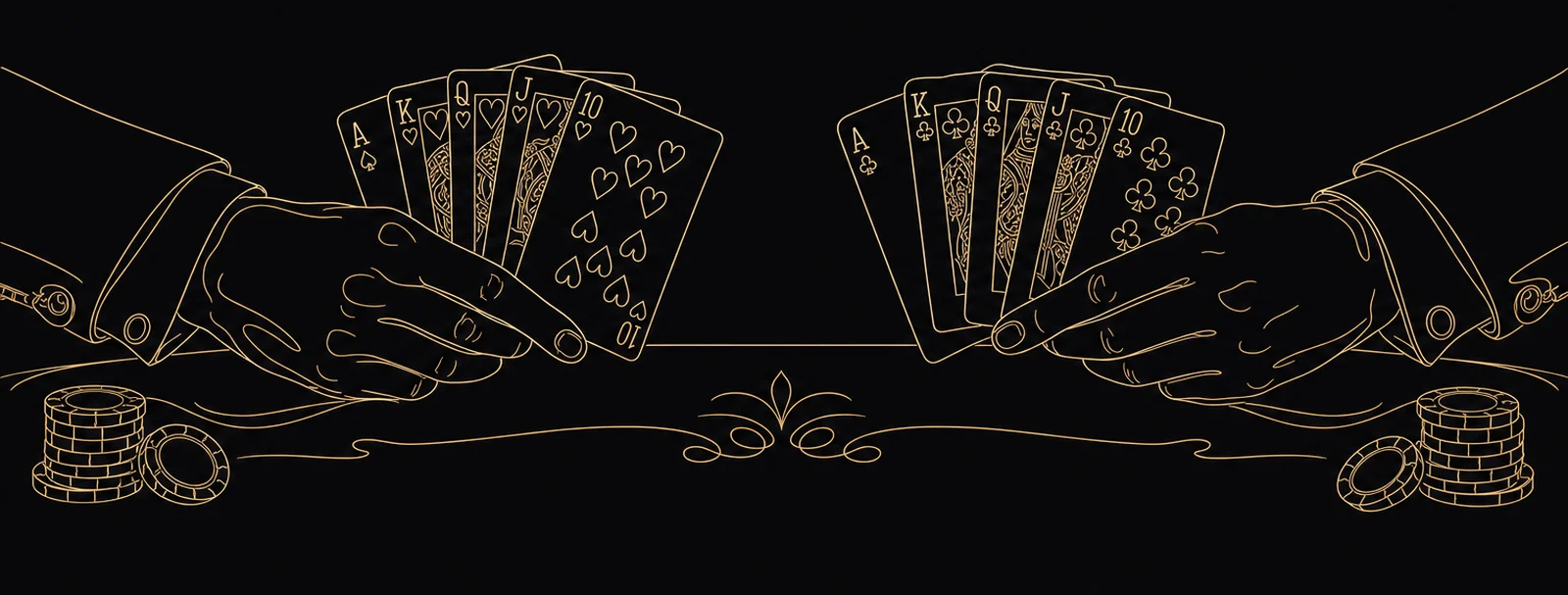
Kickers: how identical hands get settled
Most showdown arguments are kicker arguments. When two players hold the same made hand, the unused cards - the kickers - break the tie, compared one at a time from the top. A pair of tens with an ace kicker beats a pair of tens with a king. Two pair goes pair by pair: aces and sixes beats kings and queens because the top pair is compared first. Only when all five cards match in rank does the pot split.
In Hold'em this cuts both ways. Your hand is always the best five of your two hole cards plus the five community cards, which means the board can kick for you - or replace your kicker entirely. If the board reads A-A-K-K-Q and you hold a jack, you are "playing the board", and so is everyone else who cannot beat it. Reading these spots quickly is a skill of its own, and the Showdown Trainer exists precisely to drill it.
How ties are settled
| Situation | What decides it |
|---|---|
| Pair vs pair | The higher pair; if equal, kickers from the top down |
| Two pair vs two pair | Top pair first, then the second pair, then the kicker |
| Straight vs straight | The higher top card of the run; suits never matter |
| Flush vs flush | Highest card, then the next, down all five |
| Full house vs full house | The three-of-a-kind part first, then the pair |
| Identical five cards | The pot splits; suits never break a tie |
What the odds mean at the table
The right-hand column above quotes the chance of being dealt each hand in five random cards. That is the clean mathematical baseline, and it explains the ladder - but at a Hold'em table you see seven cards by the river, so everything arrives more often. You will flop a set roughly once every nine times you see a flop with a pocket pair, and a flush draw completes by the river about 35 percent of the time. Those working numbers live in the outs and equity guide, and the habit of using them is built in the Odds Trainer.
The practical lesson from the rarity table is about expectations. Full houses are once-an-evening hands, not once-an-hour hands. One pair and high card together account for over ninety percent of five-card deals - which is why so much of real poker is small pots, thin values and well-timed folds rather than parades of monsters. Players who internalise this stop overpaying to chase the top of the ladder, and start winning the unglamorous middle of it. Good starting-hand discipline is where that begins.
How many ways each hand can be made
The ladder is a count. Deal five cards from a 52-card deck and there are 2,598,960 possible hands; every rung of the chart is simply a smaller slice of that number. The second table counts the Hold'em version, where the best five are picked from seven cards and the pool grows to 133,784,560 combinations. Watch the bottom rows swap places: with seven cards, one pair turns up more often than high card, and two pair jumps from about 5% to nearly a quarter of all finished hands.
| Hand | 5-card hands | Share of 5 cards | Best 5 of 7 cards | Share of 7 cards |
|---|---|---|---|---|
| Royal flush | 4 | 0.00015% | 4,324 | 0.0032% |
| Straight flush | 36 | 0.0014% | 37,260 | 0.028% |
| Four of a kind | 624 | 0.024% | 224,848 | 0.168% |
| Full house | 3,744 | 0.144% | 3,473,184 | 2.60% |
| Flush | 5,108 | 0.197% | 4,047,644 | 3.03% |
| Straight | 10,200 | 0.392% | 6,180,020 | 4.62% |
| Three of a kind | 54,912 | 2.11% | 6,461,620 | 4.83% |
| Two pair | 123,552 | 4.75% | 31,433,400 | 23.5% |
| One pair | 1,098,240 | 42.3% | 58,627,800 | 43.8% |
| High card | 1,302,540 | 50.1% | 23,294,460 | 17.4% |
One oddity sits in that seven-card column: flushes are made more often than full houses, yet the flush still ranks lower. The order was fixed for five-card games long before Hold'em, and nobody rewrote it. It does not change a single decision, but it wins a surprising number of bar arguments.
Does it beat it? The pairings people ask about
When the order changes: other games
The chart above holds for Hold'em, Omaha, Seven-Card Stud and Jacks or Better. A handful of games bend it, and they are worth knowing before you sit down at one of them.
- Three Card Poker. With three cards, a straight is harder to make than a flush, so the house table ranks straight above flush, and three of a kind above both.
- Short Deck (6+ Hold'em). The twos to fives are removed, which makes flushes scarcer: a flush beats a full house, and A-6-7-8-9 plays as the lowest straight. Some rooms also rank three of a kind above a straight.
- Lowball. The ladder runs upside down on purpose. In ace-to-five the best hand is 5-4-3-2-A; in deuce-to-seven it is 7-5-4-3-2 and straights and flushes count against you.
- Hi-Lo split games. Omaha Hi-Lo and Stud Hi-Lo award half the pot to the best high hand and half to the best qualifying low of eight or better - the full rules are on the Omaha page.
Quick check: which hand wins?
Five showdowns, one tap each. The answers explain themselves, and the full drill lives in the showdown trainer.
Prefer paper? The printable hand rankings sheet puts the whole chart, the counts and the tie rules on one A4 page.
Learn the ten poker hands in order as a reflex
Nobody plays well while mentally scrolling a chart. The rankings need to live in your hands: see three hearts on the board and feel the flush possibility before you finish reading the ranks. That speed comes only from repetition. Run the Hand Trainer until the ten poker hands are automatic, then pressure-test yourself in the Showdown Trainer, where five-card boards come fast and the dealer's eye is the standard to beat. Ten minutes a day for a week is usually enough - after that, take a seat at the free Hold'em table and let the reflex earn its keep.