A bonus game between hands
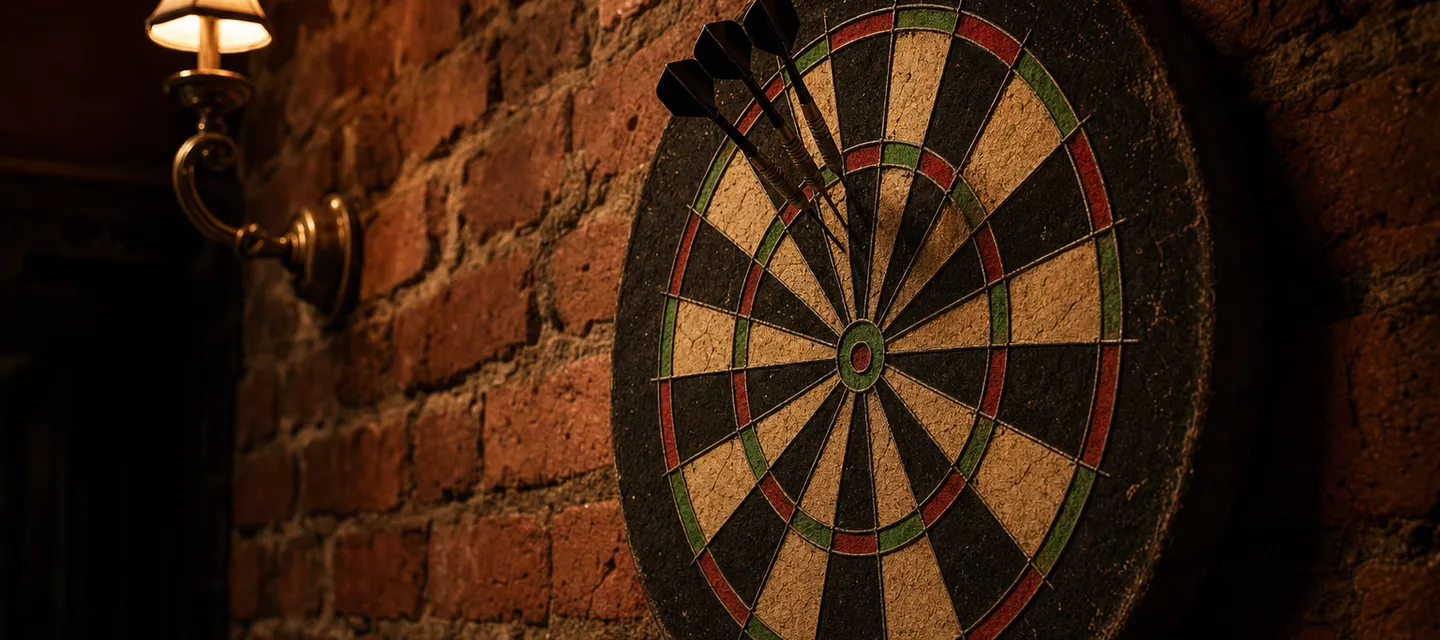
Every clubroom worth the name has a dartboard on the wall, and this one is no different. The lounge is built for poker, but the board is here for the moments between deals - a quick, honest game of aim and arithmetic that asks nothing of your bankroll because there is no bankroll. Line up the throw, release, and watch the score come off. It is the same board you would find in any pub, rendered in the same black and gold as the rest of the room.
The game above is the real thing, not a demo. It tracks your score, enforces the finishing rules and keeps a high score for the shortest leg you manage. Throw a handful of rounds and the rhythm returns quickly, whether or not you have stood at a real oche before.
How the board is scored
The dartboard is split into twenty numbered wedges arranged so that big numbers sit beside small ones, punishing a loose throw. Each wedge carries a thin outer ring that doubles its value and a thin inner ring that trebles it. The centre holds two targets: the green outer bull worth twenty-five and the red bullseye worth fifty. That layout is why the treble twenty, a sliver of board barely wider than a matchstick, is the most valuable single target in the game at sixty points.
A standard leg starts at 501. Every dart subtracts from that total, and the race is to reach exactly zero. Overshoot the number, or leave yourself on one, and the throw busts: the score resets to where the visit began. The game rewards players who think a throw or two ahead rather than simply aiming at the biggest number every time.
Finishing on a double
The rule that gives darts its tension is the checkout. You cannot simply count down to zero with any dart. The final throw of a leg must land in a double - the outer ring of a number, or the bullseye, which counts as a double of twenty-five. That single condition turns the last few darts into a small puzzle. Sit on 40 and the answer is clean: double twenty. Sit on an awkward odd number like 41 and you have to score a single first to leave yourself on an even double, all without busting.
Learning the common checkouts is the fastest way to improve. Forty, thirty-two and sixteen are the friendly ones, each a straight double or a single that sets up a double. The high finishes above a hundred are where the show-stoppers live, and where a careless dart costs you the whole visit.
Chasing the nine-dart leg
The perfect leg closes 501 in nine darts, the smallest number the maths allows. The classic route opens with three treble twenties for a hundred and eighty, repeats them, and then finds a checkout worth a hundred and forty-one across the last three throws. It is rare enough on a real stage to stop a tournament in its tracks, and it is exactly what the high-score mode is built around. You will not hit it often, but the moment you string together two maximum visits you will feel how close it can come.
Treat it the way you treat the poker tables: a skill you drill for the pleasure of getting sharper, not for anything it pays out. When you have had your fill of the board, the felt is a click away, and the free tables are always open.
Legends of the oche
Darts has its own royalty, and their numbers read like poker hand odds - improbable until you watch them happen. Phil Taylor dominated the sport for two decades and remains its reference point; Michael van Gerwen turned speed into an art form; and in 2024 and 2025 the world title went to a new generation, with Luke Humphries winning his first crown and 17-year-old Luke Littler becoming the youngest world champion the sport has ever seen.
| Player | PDC world titles | Known for |
|---|---|---|
| Phil Taylor | 14 | The Power - the most decorated player in the history of the game |
| Michael van Gerwen | 3 | Relentless scoring pace and three world crowns before turning 30 |
| Gary Anderson | 2 | The Flying Scotsman - back-to-back world titles in 2015 and 2016 |
| Peter Wright | 2 | Snakebite - two world titles and the boldest mohawk on television |
| Raymond van Barneveld | 1 | Five world titles across both codes and darts' great gentleman |
| Luke Humphries | 1 | Cool Hand Luke - world champion in 2024 at the top of the rankings |
| Luke Littler | 1 | World champion in 2025 at 17 - the youngest in the sport's history |
The checkouts worth memorising
A leg of 501 ends on a double, and the good players walk to the oche already knowing the route. These are the classic finishes - learn the two or three you hit most and the board stops feeling random.
| Score | Route | The name it goes by |
|---|---|---|
| 170 | T20 · T20 · Bull | The Big Fish - the maximum possible checkout |
| 167 | T20 · T19 · Bull | A champion's out - three perfect darts |
| 160 | T20 · T20 · D20 | Tops to finish under the brightest lights |
| 132 | Bull · Bull · D16 | The showman's route through the middle |
| 100 | T20 · D20 | The ton-out, two darts, no drama |
| 40 | D20 | Tops - the double every player grows up on |
| 32 | D16 | The pro's favourite leave - it halves kindly |
Notice the pattern in that last row: professionals steer their legs toward 32 because a missed double 16 leaves double 8, which leaves double 4 - the leg keeps offering you another double without a setup dart. That is the same instinct poker rewards: think one street ahead, and arrange the hand so your next decision is an easy one.