How the table works
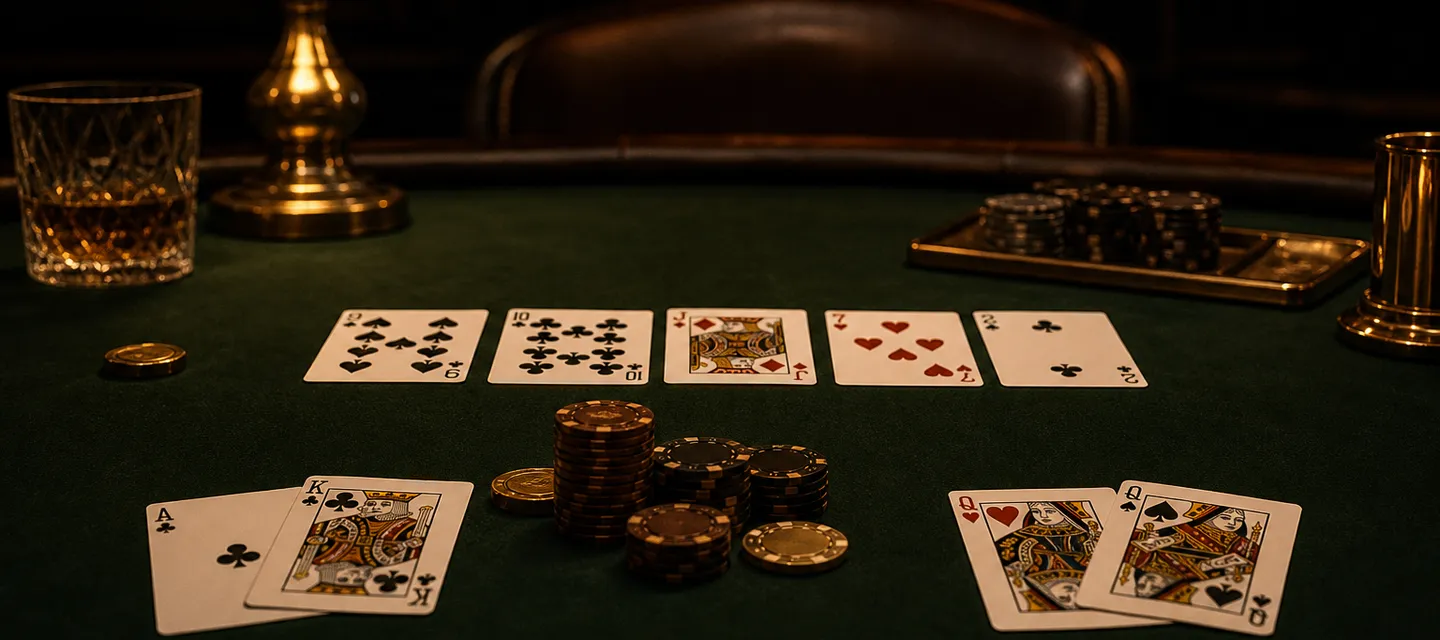
The Equity Lab gives you an empty felt and a card picker. Tap the two slots under Your Hand and choose your hole cards from the grid; add up to five board cards if you want a flop, turn or river spot; then pick how many opponents you are up against, anywhere from one to eight. Press Calculate and the lab deals 25,000 random runouts against random opponent hands, with a progress bar tracking the count.
The results come back as three bars: win, tie and lose, each with its exact percentage. Your equity counts wins plus half of ties, which is the standard accounting. Below the bars sits a made-hand distribution table showing how often your hand ends up as a flush, two pair, a lonely high card and so on by the river - often the more surprising number. A verdict line translates the math into table talk, from "Dominating - bet big for value" down to "Crushed - fold unless priced in". Reset clears the felt for the next spot.
The discipline that makes it a trainer is yours to supply: say your estimate out loud before you press the button. Guess, then verify. Do that fifty times and your guesses stop being guesses. The lab keeps no score and runs no clock - it answers exactly the spot you set up, every time, which makes it less a game than an instrument, and instruments reward the people who show up daily.
Set the spot, say your number out loud, then let the lab correct you.
Numbers worth memorising
A handful of matchups cover most of the arguments you will ever have at a table. Set each one up in the lab and watch the bars agree.
| Spot | Approx. equity |
|---|---|
| A-A vs K-K, preflop | 82% |
| K-K vs A-K suited, preflop | 66% |
| A-K vs A-Q, preflop | 74% |
| Q-Q vs A-K suited, preflop | 54% |
| 2-2 vs A-K offsuit, preflop | 53% |
| Flush draw vs top pair, on the flop | 35% |
Two lessons hide in that table. First, "coin flip" is a real thing: a small pair against two big cards is nearly even money, which is why tournament players shrug and shove. Second, domination is brutal - the same ace-king that flips against a pair is a three-to-one favourite over ace-queen. Add opponents and everything shrinks: aces are about 85 percent against one random hand, and the lab will show you how quickly that melts as you fill the other seats.
- Guess before you press - the correction is the training; pressing first is just reading
- Drill the classic matchups until they are furniture: pair versus overcards, domination, the flush draw
- Add opponents to the same hand and watch strong equity melt - aces are not aces five-handed
- Convert outs to equity with the rule of 2 and 4, then verify here
- Ten deliberate spots a day beat a hundred idle ones
Common beginner mistakes
- Calculating first and guessing never
- Only ever testing heads-up spots
- Confusing equity with pot odds - one is your share, the other is the price
- Ignoring ties, which quietly pad equity in split-heavy spots
- Memorising numbers without ever feeling why they move
What it trains
Equity estimation is the skill that prices every bet you ever face, and almost nobody practices it deliberately. The shortcut most players lean on is the rule of four and two - multiply your outs by four with two cards to come, by two with one - and the lab is the place to find out where the shortcut bends. Nine outs to a flush on the flop estimates to 36 percent; the true figure is 35. Close enough to bet on, and now you know it firsthand rather than on faith.
It also builds the bridge to pot odds: equity tells you how often you win, pot odds tell you the price, and a profitable call is just the first number beating the second. Drill spots here until the comparison is automatic, then take it to the Hold'em Table where the chips move. The rest of the games floor works the same muscle from other angles.
Tips from the rail
- Estimate before every calculation, out loud, because an unspoken guess conveniently becomes whatever the result says it was.
- Run the same hand across three boards - one that helps you, one that misses you, one that scares everyone - and watch how much of your equity lives in the flop rather than in your cards.
- Add opponents one at a time to the same spot. Top pair that dominates heads-up becomes a modest favourite three ways, and that shrinkage is why loose multiway pots punish thin value bets.
- Check the made-hand distribution, since knowing you win 60 percent matters less than knowing whether you win with a pair that needs to dodge or a flush that does not.
- When a result surprises you, count your outs by hand and reconcile the difference - the gap between your count and the simulation is usually a blocked out or a dirty one you double-counted.