How to play, step by step
- Open the gallery. The table greets you with all ten poker hands ranked strongest to weakest. Hover a hand to fan its five cards; click it for the full rules, the tie-breakers and the odds of being dealt it.
- Start the quiz. Press the quiz button and the dealer lays out five cards with one question: which hand is this? Pick one of the four answers.
- Build a streak. Every correct answer extends your run. A miss shows you the right answer, explains it, and resets the streak - your best run is saved in this browser.
- Stop when it is reflex. The drill has done its job the day you name the hand before you finish counting the cards. Most players get there inside a few short sessions.
The rules in short
Every hand you will ever hold sorts into one of ten categories, and the order never changes: royal flush, straight flush, four of a kind, full house, flush, straight, three of a kind, two pair, one pair, high card. A rarer category always beats a more common one. Inside the same category, ties break by card rank - the higher set, the higher pair, the better kicker - and when the five best cards are identical, the pot splits. The ace plays high or low in a straight, suits never decide a winner, and only the best five cards count no matter how many are on the table.
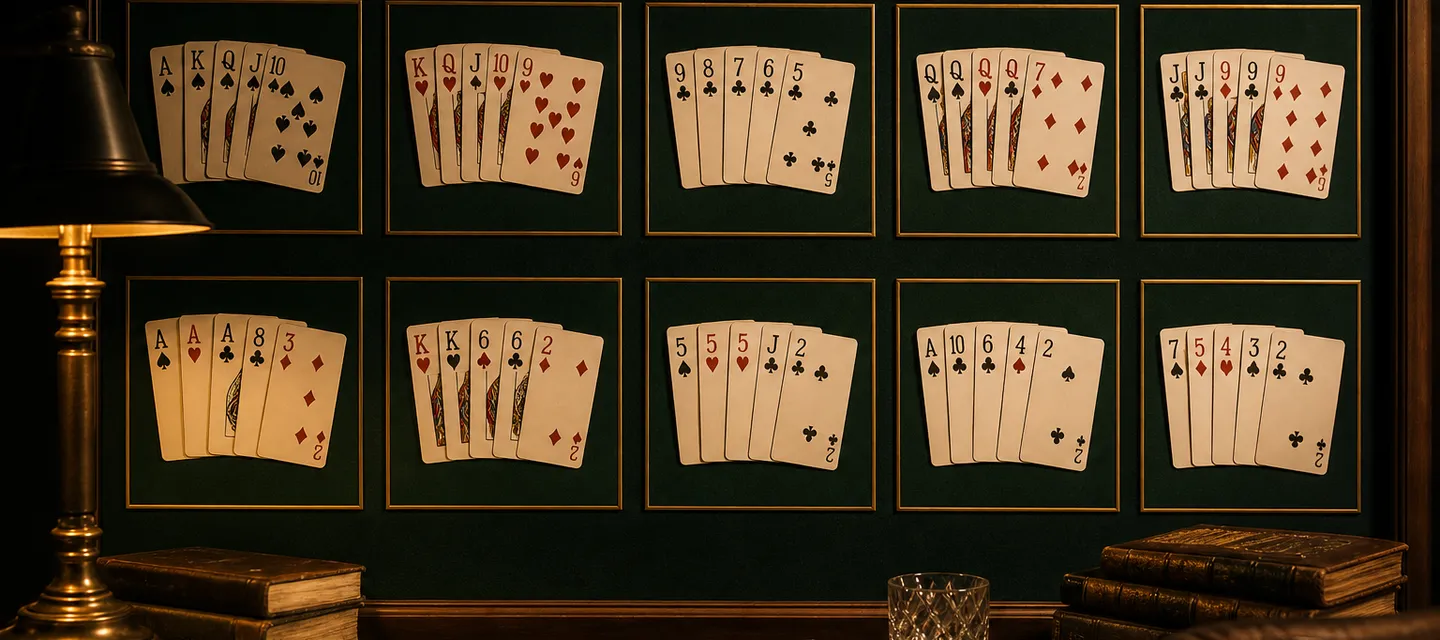
How the table works
The table opens as a ranked gallery of all ten poker hands, from the royal flush at the top down to high card at the bottom. Hover any hand and its five cards fan out; click and it opens up with the full definition, a plain-English description of how the hand is built, the tie-breaking rules that decide identical categories, and the exact odds of being dealt it in five random cards from a single 52-card deck. The tie-break notes earn their keep - most players know a flush beats a straight, far fewer know what happens when two full houses collide.
Then there is the quiz. Press the quiz button and the table deals five cards and asks one question: which hand is this? Four options, one right answer. Correct picks build a streak; a miss reveals the right answer and resets the streak to zero, though your best run is saved in the browser and survives the tab closing. The hands are built constructively - the dealer decides on a category first, then assembles cards to match - so the rare monsters show up often enough to actually practice, which is more than a random deck would ever allow.
How rare is each hand
The ranking order is just a frequency chart read top to bottom, and the numbers are worth a look. There are exactly four royal flushes in a deck, so a random five-card deal produces one every 649,740 hands. A straight flush shows up once in 72,193 deals, four of a kind once in 4,165, a full house once in 694, a flush once in 509. Down at the working end of the ladder, three of a kind arrives once in 47 hands, two pair once in 21, and a single pair turns up 42.3 percent of the time. High card - no pair, no draw, no story - is the most common result of all at 50.1 percent. Half of everything you are ever dealt is nothing.
That frequency logic explains the one ordering that trips people up: a flush outranks a straight because there are 5,108 ways to make a flush and 10,200 ways to make a straight. Rarer hand, higher rank, no exceptions. The same logic puts the full house above the flush - 3,744 combinations against 5,108. The full breakdown, with the combinatorics behind each count, lives in our poker hand rankings guide.
What it trains
Recognition speed. Knowing the rankings in the abstract is not the same skill as looking at five cards and naming them without pause, and the second one is what a poker table actually demands. Every misread costs real equity: call a straight a flush and you have just priced a pot wrong; miss the pair sitting inside your busted draw and you fold a winner. The quiz keeps dealing until the naming happens on sight rather than by checklist, and when it does, the Showdown Trainer is waiting to add a board, a second hand and a clock's worth of pressure.
It is also the entry ticket to every other table on the games floor. Video poker assumes you spot a four-flush instantly, the equity drills assume you know what you are drawing to, and the full ring game assumes all of it at once. Ten minutes here saves an hour of confusion everywhere else - a fair trade, as poker bargains go. Our guide on how to practice poker makes the case for exactly this kind of narrow, repeatable drill.
Common beginner mistakes
- Learning the list top-down instead of as two families - pairs and their upgrades, straights and flushes
- Answering "flush" before checking whether five suited cards also make a straight flush
- Forgetting the ace plays both high and low in straights - but never wraps a corner
- Skipping the tie-break notes and losing imaginary pots to kickers
- One long session instead of short daily runs - reflexes are built by frequency
Tips from the rail
- Learn the ladder as two families - pairs and their upgrades on one side, straights and flushes on the other - because sorting a hand into its family first cuts the ten options down to three or four instantly.
- When the quiz shows five suited cards, check for the straight before answering, since flush is the reflex answer and straight flush is the one the constructive dealer loves to hide inside it.
- Remember that the ace plays high or low in a straight - ace through five is the wheel, ten through ace is Broadway - but it never wraps around a corner, and king-ace-two is nothing at all.
- Read the tie-break note on every hand you miss, because "two pair versus two pair" pots are decided by rules most players have never actually learned, and those pots are not small.
- Chase your best streak in short daily sessions rather than one long grind - recognition is a reflex, and reflexes are built by frequency, and frequency beats duration every time.