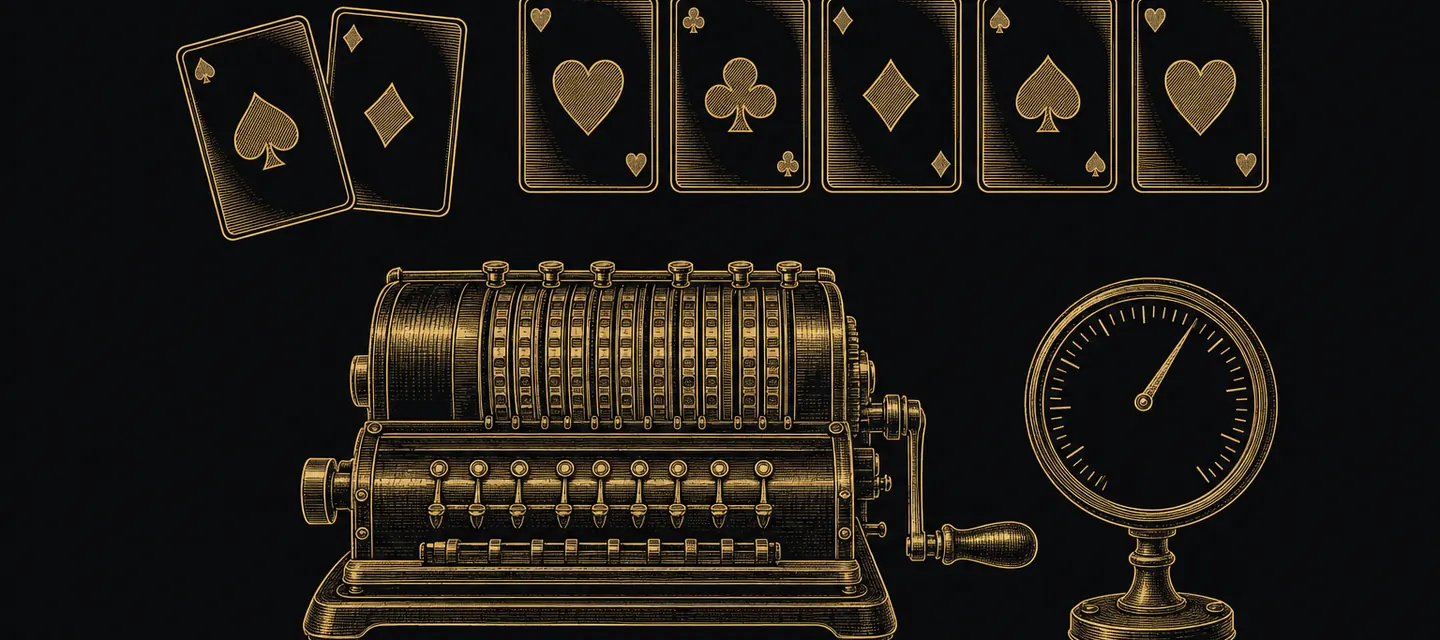
Pocket twos against ace-king, all the chips in before the flop. The twos win 53.04% of the pot and the ace-king 46.96%, counted across every one of the 1,712,304 boards that can come. That is the kind of number this page gives you for any spot you can deal: pick the cards below, press Calculate, and read the result.
Dead cards folded or exposed cards, optional
| Hand | Win | Tie | Equity |
|---|
The check treats the hand as all in. With chips still behind, price one street at a time as our guide to pot odds and calling prices explains.
Three spots, run through the calculator
Every number in this section came out of the tool above. Paste the hands in and you will get the same figures, because the heads-up and three-way preflop spots are counted exactly rather than sampled.
1. The coin flip that is not quite one
Pocket twos (2♣︎ 2♦︎) against A♥︎ K♠︎, all in preflop. Players call this a flip, and it nearly is: the twos win 52.75% of boards outright, ace-king wins 46.67%, and 0.58% of boards split. Equity comes to 53.04% against 46.96%. Six points sounds like nothing, but in a pot of 200 big blinds it is worth twelve of them every time the hand is played.
2. The draw that is ahead of the made hand
You hold 9♥︎ 8♥︎ on a flop of T♥︎ 7♣︎ 2♥︎. Your opponent has A♠︎ K♦︎ and nothing yet but two overcards. With 990 turn-and-river combinations left, the calculator counts all of them: 68.79% for the draw, 31.21% for ace-king. The hand-class panel shows where that comes from. Hand 1 finishes with a flush on 36.06% of run-outs and a straight on 19.70%, with another 0.30% of straight flushes on top.
Now let the turn bring the K♣︎. Ace-king has top pair, and the draw drops to 34.09%: fifteen outs from 44 unseen cards, the same figure you get counting outs by hand. If your opponent bets the size of the pot, you need 33.3% to call (the pot odds table for common bet sizes has the other prices), which leaves you 0.8 points clear. That is about as close as a correct call gets, and precisely the sort of spot where a player guessing from feel gets it wrong in both directions.
3. Three-way, and the hand nobody fears
Aces, kings and 7♠︎ 6♠︎ all in before the flop. The calculator runs every one of the 1,370,754 boards: aces 61.04%, the suited connector 21.16%, kings 17.80%. Compare that with aces against kings on their own, where the split is 81.26% to 18.74%. Adding the 7-6 costs the kings less than one point. Nearly all of its 21% comes out of the aces, because the straights and flushes it makes beat whichever overpair it is up against.
| Spot | Hand | Equity |
|---|---|---|
| Preflop, heads-up | 2♣︎2♦︎ v A♥︎K♠︎ | 53.04% / 46.96% |
| Flop T♥︎7♣︎2♥︎ | 9♥︎8♥︎ v A♠︎K♦︎ | 68.79% / 31.21% |
| Turn K♣︎ | 9♥︎8♥︎ v A♠︎K♦︎ | 34.09% / 65.91% |
| Preflop, three-way | AA v KK v 7♠︎6♠︎ | 61.04 / 17.80 / 21.16 |
How the calculator gets its numbers
There are two ways to find a hand's equity, and the tool picks between them for you. The first is enumeration: list every card that is still unseen, deal every possible combination of the remaining board, and score each one. It is exact, it is repeatable, and on the turn it takes a fraction of a millisecond because there are only 44 rivers. Heads-up before the flop it means 1,712,304 boards, which takes a second or two in a browser, with the progress bar ticking along. With six named hands there are fewer boards left (658,008) but six hands to score on each.
The second is simulation, called Monte Carlo after the casino in Monaco by the physicists at Los Alamos who used it in the 1940s. When you leave a hand or a single card random, the number of possible deals explodes, so the calculator deals a large random sample of run-outs instead and reports the share each hand wins. At 100,000 run-outs a hand near 50% is accurate to about ±0.3 percentage points 95 times in 100, and the result panel prints the margin whenever it samples. Quadruple the run-outs and the margin halves. That is why the Fine setting exists and why nobody needs more than it.
Both methods lean on the part that does the real work: a seven-card hand evaluator that has to rank any seven cards correctly and quickly. Before this page went up we fed every possible seven-card hand through it, all 133,784,560 of them, and compared the counts with the table on Wikipedia's Poker probability page. All nine categories match to the hand, from 41,584 straight flushes to 23,294,460 hands that end as nothing better than high card. As a second check, pocket aces against pocket kings, averaged over their suit combinations, comes out at 81.95%, the familiar 82/18 split that PokerStove and every equity tool since have reported. The exact figure moves with the suits: 82.64% when the kings share both suits with the aces, 81.26% when they share none.
| Final hand | Combinations | Frequency |
|---|---|---|
| Straight flush | 41,584 | 0.031% |
| Four of a kind | 224,848 | 0.168% |
| Full house | 3,473,184 | 2.60% |
| Flush | 4,047,644 | 3.03% |
| Straight | 6,180,020 | 4.62% |
| Three of a kind | 6,461,620 | 4.83% |
| Two pair | 31,433,400 | 23.50% |
| One pair | 58,627,800 | 43.82% |
| High card | 23,294,460 | 17.41% |
One oddity worth a look: with seven cards, finishing with high card (17.41%) is rarer than finishing with two pair (23.50%). Seven cards give you so many chances to pair something that ending up with nothing is the harder trick. If the ranking order itself needs a refresher, our poker hand rankings chart lays it out with the tie-breaking rules.
Why ties split the pot
Put A♥︎ K♦︎ against A♣︎ K♠︎. On 95.65% of boards both players end with the same five-card hand and the pot is chopped. Each hand wins outright only 2.17% of the time, always with a flush in one of its suits. A calculator that only counted wins would call this hand a 2% shot for both players, which is nonsense. So a tie counts as a share of the pot: half of it when two hands tie, a third in a three-way chop. Equity is wins plus those shares, which is why the Win and Tie columns never add up to the Equity column on their own and why AK against AK comes out at exactly 50.00% each.
Equity is where the decision starts
The calculator compares hands, and real opponents do not show you one. What you face is a range, the whole set of holdings a player would bet like this with, and your equity against that range is an average over it. A useful habit is to run your hand against two or three hands from the likely range, the strongest and the most common, and watch how far the number moves. When it barely moves you can stop worrying about the read. Our starting hands guide by position is a good place to decide which hands belong in a range before the flop.
Equity also says nothing about the betting to come. The 9♥︎ 8♥︎ draw above is a 68.79% favourite on the flop, but only if both cards arrive for free. Once there is a bet to face on each street, what matters is the price of the call against your chance of hitting on the next card, and the pot odds box under the result does that sum for you. For the mental version, the odds hub with charts for outs and draws has the tables players memorise, and the odds trainer that deals out practice spots turns those tables into reflexes.
A final quirk that surprises people the first time they see it. Deal pocket aces against five random hands and their equity falls from about 85% heads-up to just under 50%, while each random hand holds around 10%. In a six-way pot the average share is one sixth, 16.7%, so the aces are still collecting nearly three times their seat's worth.