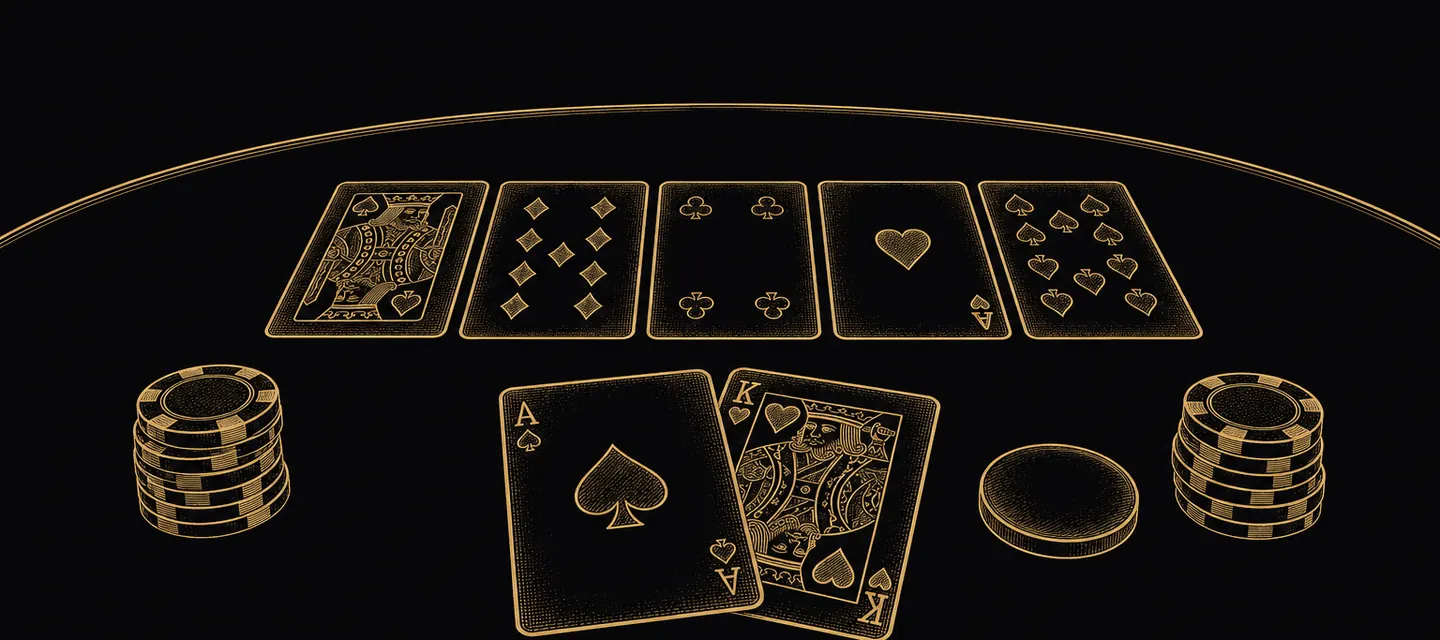
You are on the button holding the ace and jack of spades. One player has raised, the flop is still three cards away, and you have four choices: fold, call, raise, or, in a no-limit game, push every chip you own into the middle. Texas Hold'em is that moment repeated up to four times a hand. The rules below frame it, and further down we follow this exact hand to the river with every chip counted.
What you are playing for
Texas Hold'em takes two to ten players and a standard 52-card deck with no jokers. Each player gets two private cards, the hole cards. Five community cards are then dealt face up in the middle in three stages, and everyone shares them. Your hand is the best five-card combination you can make from those seven cards: both hole cards, one, or none at all.
There are two ways to win the pot. Hold the best hand when the cards are turned over at the end, or bet so that everyone else folds before that. The second happens far more often than television suggests. The ranking of hands, from high card to royal flush, is the same as in every other standard poker game and is laid out on our poker hands page.
The button, the blinds and the deal
A round disc called the dealer button marks who is dealing, at least in principle. In a casino a house dealer handles the cards; the button just tells everyone where the order starts. After each hand it moves one seat clockwise, so every seat takes a turn at every position.
The two players to the left of the button post forced bets before any cards arrive. The small blind is usually half the big blind: in a $1/$2 game they post $1 and $2. Those blinds exist so there is always something to fight over. They are live bets, which matters: if everyone simply calls the $2, the big blind still gets the chance to raise before the flop comes. Dealers call this the option.
The cards go out one at a time, clockwise, starting with the small blind, until everyone has two. One exception is worth learning now. When only two players are left, the button posts the small blind, acts first before the flop and last on every street after it. Why seat order matters so much is its own topic, covered on our position page.
- 0Blinds + dealTwo hole cards each
- 1Preflopno boardFirst to act: left of the big blind
- 2FlopFirst to act: left of the button
- 3TurnSame order as the flop
- 4RiverLast round of betting
- 5Showdownbest 5 of 7Last aggressor shows first
Four rounds of betting
Preflop. With hole cards dealt, the player to the left of the big blind, known as under the gun, acts first. There is already a bet in the pot, the big blind, so nobody can check: you fold, call $2, or raise. Play moves clockwise and the big blind acts last. The round ends once every player still in has put in the same amount and everyone has had a turn to act.
The flop. The dealer burns one card and turns three face up. From now on the first player still in the hand to the left of the button speaks first. Nobody has bet on this round yet, so checking becomes possible.
The turn. One more burn, one more card, one more round in the same order.
The river. The fifth and final community card, followed by the last round of betting. If two or more players remain after it, the hand goes to a showdown.
At every turn to act, your options depend on one question: has anyone bet yet on this round?
| Action | When you can | What it does |
|---|---|---|
| Check | No bet yet this round | Pass without putting chips in; you keep your cards |
| Bet | No bet yet this round | Put the first chips of the round into the pot |
| Call | Facing a bet | Match the current bet exactly |
| Raise | Facing a bet | Increase it; everyone else must match or fold |
| Fold | Any time it is your turn | Give up your cards and any claim on the pot |
| All in | Any time it is your turn | Put in every chip you have; you can win only what you matched |
One hand, street by street
Back to the ace and jack of spades. Six players, $1/$2 blinds, everyone starting with $200. You are on the button.
Preflop. Under the gun folds. Dan, in the hijack, raises to $6. The cutoff folds. A♠J♠ suited on the button is a comfortable call, a hand our starting hands guide plays from late position without a second thought, so you call $6. The small blind folds, leaving their $1 behind. Priya in the big blind calls $4 more to make her $6. Pot: $6 + $6 + $6 + $1 = $19.
Flop: J♥ 8♠ 3♠. You have top pair and a flush draw. Priya checks. Dan bets $12. You call; you are getting $31 for your $12, a price our pot odds guide shows you how to read, and your hand is ahead of plenty of what Dan bets here anyway. Priya folds. Pot: $19 + $12 + $12 = $43.
Turn: 5♦. A blank. Dan checks. You bet $25 and Dan calls. Pot: $43 + $50 = $93.
River: Q♠. The flush arrives. Dan checks again, you bet $60, and he calls. Pot: $93 + $120 = $213.
Showdown. You made the last bet, so you show first: A♠ J♠ with Q♠ 8♠ 3♠ on the board, an ace-high flush. Dan turns over K♣ J♦ for a pair of jacks with a king kicker. You take $213. Dan put in $103 with a hand that looked strong on the flop and never improved, which is the most ordinary story in poker. You can play the same spot as often as you like at the free Hold'em table, where the chips are worth nothing and the decisions are real.
Showdown and the best five of seven
If the river betting ends with a bet and a call, the player who made the last bet or raise shows first. If everyone checked the river, the first player to the left of the button shows first. A player who is beaten can usually muck face down without showing. The winner has to table both hole cards: at nearly every casino the cards speak, so the dealer reads the hand rather than taking your word for it, but only cards that are face up on the felt can be read.
Three situations cause most showdown arguments in Hold'em.
The kicker. Board K♠ 9♦ 7♣ 4♥ 2♠. You hold A♥ K♦, your opponent K♣ Q♣. Both of you have a pair of kings, and the next cards decide it: your five are K K A 9 7, theirs K K Q 9 7. The ace kicker wins.
The kicker that does not play. Board K♠ K♦ 9♣ 9♥ A♠. You hold Q♦ J♦, your opponent 8♣ 7♣. You feel ahead with your queen. You are not: the best five for both players is K K 9 9 A, all on the board, and the pot is split. Only five cards count, and the ace on the board already filled the fifth slot.
The board plays. Board A♠ K♦ Q♣ J♥ T♠, a straight on the table. Anyone who has not folded holds at least that straight, so everyone still in splits the pot. Suits never break a tie. If the pot cannot be divided evenly, Robert's Rules of Poker, the rulebook many cardrooms adopt, gives the odd chip to the first tied player clockwise from the button.
Side pots, worked out
The all-in rule is the part of Hold'em that sounds unfair until you see the arithmetic. A player can only win from each opponent as much as they themselves put in. Say three players get it all in before the flop, and to keep the numbers clean we will ignore the blinds. Ana has $50, Ben has $120, and Cleo has $200.
| Pot | How it is built | Amount | Who can win it |
|---|---|---|---|
| Main pot | $50 from each of three players | $150 | Ana, Ben, Cleo |
| Side pot | $70 more from Ben and from Cleo | $140 | Ben, Cleo |
| Returned | Cleo's last $80, which nobody could match | $80 | Back to Cleo |
Now the cards. Ana has the best hand, Cleo the second best, Ben the worst. Ana wins the $150 main pot. The side pot is decided between Ben and Cleo only, so Cleo takes $140 and her own $80 back. Ana could never win Ben's or Cleo's chips above $50, because she had no more than $50 at risk. Dealers settle the side pot first and the main pot last, which is why you will see the all-in player's cards read at the very end.
How much you can raise
In no-limit and pot-limit Hold'em a raise must be at least the size of the last full bet or raise on that round. Preflop in a $1/$2 game the big blind counts as the bet, so the smallest raise is to $4. When Dan raised to $6 he added $4, so a re-raise had to reach at least $10. On later streets it works the same way: a $12 bet can be raised to $24 or more, and if someone does make it $24, the next raise must be to at least $36.
All-ins complicate this. Under the 2024 Poker TDA rules, the rulebook most tournaments use, an all-in that is smaller than a full raise does not reopen the betting for players who have already acted. Suppose you bet $100 and a short stack moves in for $150. That is only $50 more, half a raise, so when the action returns to you, you may call the extra $50 but you may not raise again.
Limit, pot-limit and no-limit
The same deal and the same four rounds can be played under three betting structures, and they produce very different games.
No-limit is the one most people mean by Texas Hold'em: any bet from the minimum up to your whole stack, at any turn. Pot-limit caps a bet at the current size of the pot; it is the standard structure for Omaha, and our Omaha rules page works through the pot-size calculation. Limit, or fixed-limit, sets every bet in advance. In a $2/$4 limit game, bets and raises go in $2 steps before the flop and on the flop, then $4 steps on the turn and river. Robert's Rules of Poker allows a bet and three raises per round when three or more players are in, after which the betting is capped; most rooms lift the cap once only two players remain. Limit rewards patience and small edges. No-limit rewards the same things, then adds the threat that any hand can cost you everything.
Cash games and tournaments
The Texas Hold'em rules for a single hand never change, but the frame around them does. In a cash game the chips are money (or, on our tables, play chips standing in for it), the blinds stay the same all night, and you can top up between hands or leave whenever you like. One rule to know is table stakes: you can only bet what was in front of you when the hand began, so nobody can reach into a wallet mid-hand.
In a tournament everyone buys in for the same fixed number of chips, which have no cash value. The blinds rise at set intervals, most modern events add a big blind ante to speed things up, and you are out when your chips are gone. Prizes depend on how long you last. That pressure changes strategy, especially short-stacked, but a flush still beats a straight.
Rule mistakes that cost new players
Most new Hold'em players know the hand rankings. What catches them out is procedure, the things a dealer will rule on in half a second.
The string bet. You put $10 in, see the reaction, then reach back for more. That second motion is not allowed; the first forward move of chips is your action. If you want to raise, say "raise" out loud before touching chips, or push the whole amount in one motion. Saying the word protects you in every cardroom.
The oversized chip. Facing a $5 bet, you drop a single $25 chip without a word. Under both the TDA rules and Robert's Rules, that is a call, not a raise.
Acting out of turn. Folding or betting before the action reaches you gives information to players who have not acted yet. It can also bind you: in most rooms an out-of-turn action stands if nothing changes before your turn arrives.
Showing one card. Flashing a card to the player beside you usually means the whole table gets to see it. Many rooms enforce "show one, show all", and it applies after the hand as well.
Mucking a winner. Throwing your cards away at the showdown because you misread the board. Once they touch the discards they are dead, even if they would have won. Turn them face up and let the dealer read them.
Table manners
Act in reasonable time. Do not talk about a hand while it is being played, even one you have folded, because a remark about what you threw away changes the maths for the players still in it. Keep your cards on the table where the dealer can see them. Put your bets in front of you rather than throwing them into the pot, a habit called splashing that makes it impossible to count what you bet. And when you have the winning hand at the showdown, show it. Holding back the nuts to watch an opponent sweat is called slow-rolling, and it is the one breach of manners every poker room agrees on. It will not get you thrown out. It will get you remembered, and not in a way that helps.