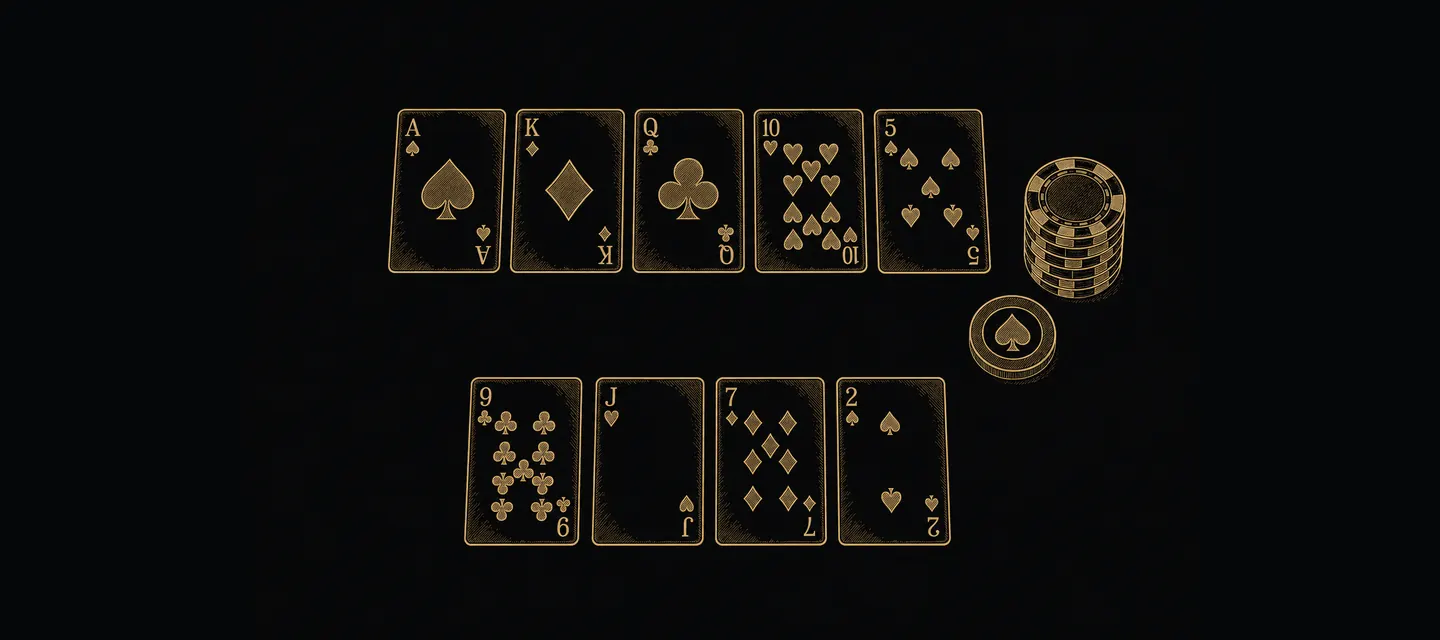
The river pairs nothing and brings a fourth spade. You hold the ace of spades, and a Hold'em player in your seat would be reaching for chips with the nut flush. In Omaha you have ace high. Nearly every Hold'em player who sits down at an Omaha table makes that mistake once, usually for a large pot, and it all comes from a single line in the rules.
The rule: exactly two, exactly three
Under standard Omaha poker rules, each player gets four hole cards instead of two. The board is dealt exactly as in Hold'em: three cards on the flop, one on the turn, one on the river. Your hand must be made from exactly two of your hole cards and exactly three of the community cards. Not one and four, not zero and five. Every other part of a standard hand, the button, the blinds, who acts first and the four rounds of betting, works as our Texas Hold'em rules describe it, and the hand ranks are the same ones on our poker hands page.
The practical effect is that four cards give you six possible pairs to work with, and you must pick one pair of them. Reading a hand means checking all six against the board, which is what the next four examples do.
What is my hand? Four boards
Ace high. No flush, no pair.
Four spades on the table and the ace of spades in your hand. In Hold'em that is the nut flush. In Omaha you need a second spade from your hand, and you do not have one. Your best legal five are A K from your hand with J 9 8 from the board.
One pair of aces.
Three aces sounds like trips. But only two of your cards count, so the third ace is dead weight, and so is the seven. A A from your hand plus K Q 9 from the board is a pair with a king kicker. Holding three of a rank is a poor starting hand for exactly this reason.
A pair of kings.
The board shows 9 8 7 6, and you hold the ten. One card completes a straight in Hold'em. Here the ten needs a partner from your hand that also fits the run, and neither the ace nor the kings do. K K with 9 8 7 is the best you can build.
Queen-high flush.
Two hearts in hand, three on the board: J♥ T♥ with Q♥ 3♥ 2♥ is a legal flush. The same two cards also make a queen-high straight with Q 9 8, but the flush ranks higher, so that is your hand.
The first example is the classic flush trap, and the rule behind it is short: with four of a suit on the board, you still need two of that suit in your hand. With three of a suit on the board, the same applies, which is why a single suited ace in your hand is worth much less than it looks. Straights follow the same logic, and so do full houses: on a board of K K 7 you need a king and a seven in your hand, or two sevens, to make a full house. A lone king gives you trips and nothing more.
Pot-limit betting and the pot-sized raise
Most Omaha is played pot-limit, which is why the game is so often just called PLO. The smallest bet is the big blind and the smallest raise follows the no-limit rule, at least the size of the last bet or raise. The largest bet is the size of the pot. For a raise, the pot is measured after you have called, and that is the part people get wrong.
Take a $40 pot. Your opponent bets $20. To raise the pot, first imagine calling: $40 + $20 + your $20 = $80. You may raise by that $80, so your total bet is $20 + $80 = $100. The shortcut dealers use is three times the bet, plus the pot before it: 3 × $20 + $40 = $100.
| Spot ($1/$2 blinds) | Working | Max raise to |
|---|---|---|
| First in, preflop | 3 × $2 + $1 | $7 |
| Re-raise a $7 open | 3 × $7 + $3 (the blinds) | $24 |
| Raise a $20 bet into $40 | 3 × $20 + $40 | $100 |
| Raise a $50 bet into $50 | 3 × $50 + $50 | $200 |
If other players have already called in front of you, add their calls to the pot figure. At a live table you can ask the dealer for the pot, and if you simply say "pot", the dealer will work out the amount for you. Rooms differ on how a short or missing blind counts towards the pot, so ask before your first session rather than in the middle of a hand.
Pot-limit sounds restrictive. It is not, for long. A pot-sized raise before the flop followed by pot-sized bets on the flop and turn commits about two thirds of a 100-big-blind stack, and the river bet covers the rest. The difference from no-limit is mostly preflop, where nobody can open by shoving a whole stack.
Omaha Hi-Lo: splitting the pot
Omaha Hi-Lo, also called Omaha 8 or better or simply O8, is most often dealt with fixed limits, though pot-limit games are common too, and it splits every pot in two. Half goes to the best high hand, read exactly as in PLO. The other half goes to the best low hand, if anyone has one that qualifies. A qualifying low is five cards of different ranks, all eight or lower. Aces count as low, and straights and flushes do not spoil a low hand, so A-2-3-4-5, the wheel, is the best low there is. Robert's Rules of Poker sets out the same eight-or-better qualifier, and it is standard wherever the game is dealt. The two-card rule applies separately to each half: you may use two different hole cards for your high and your low.
Lows are compared from the top card down. 8-6-3-2-A beats 8-6-4-3-2 because at the third card the 3 is lower than the 4. Three worked pots show how it plays out.
A scoop. Board 3♣ 6♥ 8♠ K♦ Q♣. You hold A♠ 2♦ K♣ K♥. For high you use K♣ K♥ with K♦ Q♣ 8♠, three kings. For low you use A♠ 2♦ with 3♣ 6♥ 8♠, an 8-6-3-2-A. Your opponent holds 2♣ 4♥ 9♦ 9♠: a pair of nines for high and an 8-6-4-3-2 for low. You win both halves, which is called scooping, and it is the whole aim of the game.
A split. Board 2♥ 5♣ 7♦ J♠ J♥, a $120 pot. Player A holds A♠ 3♦ Q♣ 9♥ and makes a 7-5-3-2-A low. Player B holds J♦ T♣ 9♠ 8♦, three jacks for high, but only one card of eight or lower, so no low at all. A takes $60 for low, B takes $60 for high. If two players tie for the low half, they split that half again, which players call being quartered.
No low possible. Board K♠ Q♦ 9♣ 5♥ 2♠. Only two board cards are eight or lower, and a low needs three from the board, so nobody can qualify. The best high hand takes the whole pot.
Five-card PLO
Five-card Pot-Limit Omaha deals five hole cards instead of four. The rule does not change: exactly two from your hand, three from the board. With ten two-card combinations per player, hands run even closer together, nut draws come along more often, and a hand that would be strong in four-card PLO is often only average. The Hi-Lo version with five cards is widely known as Big O. If four-card Omaha already feels busy, give it a few sessions before trying five.
Which hands to play, and why aces shrink
Good Omaha hands have all four cards working together. Three qualities matter most. Connected cards make straights in several ways; a rundown like J-T-9-8 has straight draws on a huge range of flops. Suited cards make flushes, and double-suited, two cards of each of two suits, gives you two flush chances. Ideally the suit is paired with an ace, because a flush that is not the nut flush is often beaten in Omaha. High cards matter too, because a straight or flush at the top of the range is the one you can bet with confidence. A card that fits none of the others is called a dangler, and it quietly lowers the value of the hand.
Aces are the clearest case of a Hold'em habit that does not travel. In Hold'em, a pair of aces is a huge favourite before the flop. In Omaha your opponent has six two-card combinations of their own, and aces with two unrelated cards often finish the hand as a single pair. We checked this with our own simulation script, dealing 20,000 random boards for each matchup below; figures are rounded and carry a margin of about half a percentage point.
| Game | Matchup | Aces win |
|---|---|---|
| Hold'em | A♠ A♥ against K♦ K♣ | 81% |
| Hold'em | A♠ A♥ against a random hand | 85% |
| PLO | A♠ A♥ 8♦ 3♣ against a random hand | 62% |
| PLO | A♠ A♥ 8♦ 3♣ against K♠ K♥ Q♠ J♥ | 57% |
| PLO | A♠ A♥ 8♦ 3♣ against J♣ T♦ 9♣ 8♠ | 55% |
| PLO | A♠ A♥ 8♦ 3♣ against 7♣ 6♣ 5♦ 4♦ | 52% |
| PLO | A♠ A♥ K♠ K♥ against J♣ T♣ 9♦ 8♦ | 62% |
Ragged aces against a random hand win about 62% in PLO, against 85% for aces in Hold'em. Against a low double-suited rundown they are barely ahead at all. The best aces, double-suited with a pair of kings, still only reach about 62% against a good connected hand. Aces remain the best pair to hold in Omaha. They just stop being a hand you can play on autopilot. Position counts even more than in Hold'em for the same reason: pots are bigger, draws are everywhere, and acting last is worth more, as our position guide explains.
Where Hold'em players go wrong
Learning how to play Omaha after years of Hold'em is mostly a matter of unlearning five reflexes.
Misreading the board. The four examples above cause more lost pots than any strategy leak. Before you bet the river, name your two cards and your three.
Falling in love with top pair. One pair wins a lot of Hold'em pots. In Omaha, with four or more players seeing a flop and six combinations each, somebody usually has two pair, a set or a big draw. An overpair on a coordinated board is a hand to control, not to stack off with.
Drawing to the second-best hand. A king-high flush draw looks good. Against several players holding four cards each, the ace-high flush is far more often out there than in Hold'em. The same goes for the low end of a straight: if the board is 9-8-7 and you hold 6-5, anyone with J-T has the better straight.
Playing four cards because they are four cards. A starting hand always looks like it has possibilities. Hands with a dangler, three of a rank, or no suits at all lose steadily, and they are the ones new players call with most.
Forgetting the pot cap. In pot-limit you cannot shove preflop, and on later streets the most you can bet may be less than your stack. Knowing the maximum before you act keeps you from announcing an amount the dealer then has to reduce.
Our free tables deal Hold'em for now, so there is no Omaha table in the games lobby yet. The hand-reading habit transfers anyway: the odds behind draws, which are the core of Omaha, are laid out on our poker odds hub, and the same outs arithmetic applies, only with far more outs in play.